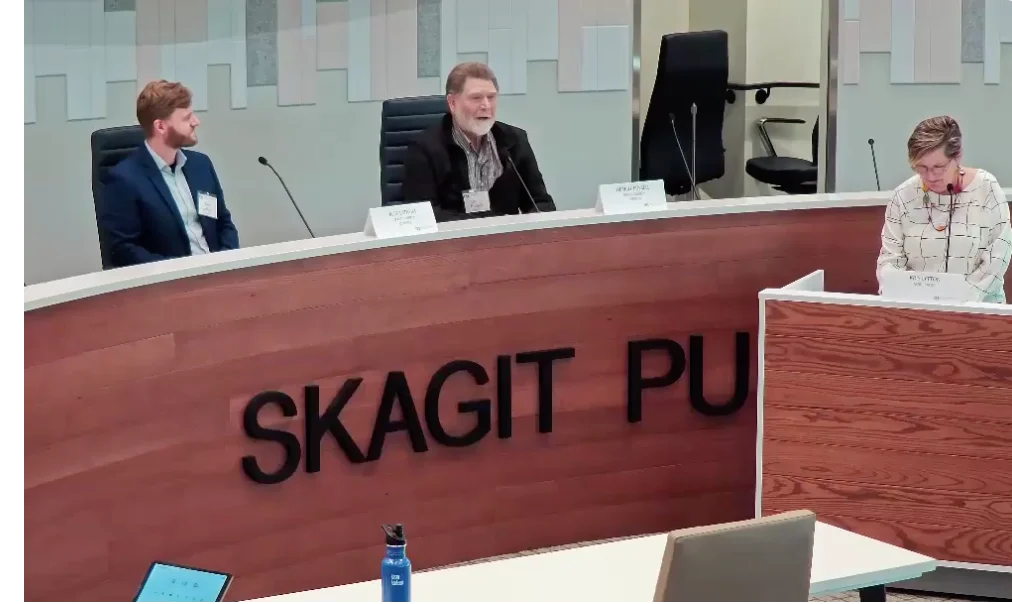
Mount Vernon, October 6, 2026
Most candidate forums end with a handshake. Monday night’s Skagit County Coroner forum ended with a job offer.
“After the election,” Derrill Fussell told the Aqua Room crowd at the Skagit PUD, “I’ll be happy to have my opponent as my deputy.”
It was the last line of the coroner segment, and it landed as applause. It also reframed the entire half hour that came before it. What the League of Women Voters had billed as a debate between two candidates had played, in hindsight, like something else: the next elected Coroner conducting a public interview for his future deputy, and finding the candidate well qualified.
Watch the forum: The full recording is posted by the League of Women Voters of Skagit County. The Coroner segment begins at 20:49.
Two men, two résumés, one job description
Fussell opened with a line that drew the first laugh of the night. “I see a lot of people out there that I know,” he said. “Possibly you’re wondering why I called this meeting.”
Then he got to the point. He has spent, in his words, “two decades and five lustrums” in administration. A lustrum is five years. That is forty-five years of running things: general manager of one of the largest flower bulb farms in the world, right here in Skagit County; inventor of a removable hard drive that caught the attention of the White House; contractor in the West Wing, the Old Executive Office Building and the Pacific Naval Command Center on Coronado Island. Budgets. Personnel. “Keeping a business afloat.”
Alex Lathum, the interim Coroner, gave a thoughtful account of his own path: a microbiologist at the state public health laboratory, lead on the COVID team, then a volunteer in the Coroner’s office who “did all the little things, even from mopping floors,” before the county commissioners appointed him to the interim post last month. He was candid about his tenure. “I have a whole three weeks as your current coroner,” he said.
That candor matters, because the first question of the night was the one that decides this race: what prior experience qualifies you for this position?
Lathum answered as an investigator. The office, he said, is “largely an investigative department,” and his laboratory background prepared him for the research the work requires.
Fussell answered as the man who signs the budget. “The Coroner’s job is an administrative position,” he said. “You must first of all know how to balance a budget, run a business, deal with personnel. All of these I have done in the past, not only in several corporations, but in my own businesses.”
Then he said something a less secure candidate would never have said out loud. Both men, he noted, “came out the gate with the same exact qualifications. We were both registered voters, and that was it.” The state-mandated coroner training comes after election. “Alex has got ahead of me on that,” Fussell said, “and that’s wonderful.”
No spin. No sniping at the other man’s certificate. A boss who is glad his future deputy already has his credentials.
The waiting room
The second question asked each candidate how he would document a death and support the family left behind. Lathum gave a careful, procedural answer about national standards and realistic timelines, including the six-month wait for some toxicology results.
Fussell did not need notes. “In this one, I lead,” he said, “because I’ve been in the waiting room of the Coroner’s office, waiting to find out when my son’s body was going to be released. When could we notify the neighbors. When could we notify our relatives. When could we have the funeral.”
The room went still.
“They should not have the second grief of not knowing anything about what’s going to happen next,” he said. The fix, in his view, belongs to the administrator: contact the family, and tell them the timeline for the autopsy, every time.
Lathum, to his credit, agreed with the principle. “One of the very first things that the office needs to do is contact families,” he said. On this point the two candidates are already a team. One of them has lived it.
Who fights the commissioners?
The sharpest contrast came on the most pressing need in the office.
Lathum named the problem honestly: people. The office runs on two full-time medicolegal death investigators and one half-time employee. He called that “a tenable solution,” then conceded it “puts us at high risk” if anyone leaves. His answer was to work harder himself: respond to scenes, cover shifts, be “the first person to mop the floors.”
Fussell’s answer was that the mop is not the problem. The budget is.
“I’ve already appeared before the commissioners’ board,” he said, “and told them the most important thing that they can do is realize that the Coroner’s job is a mandated position. It’s not optional to fund them or supply them the needs.” He said the commissioners have reduced the Coroner’s office staffing by a third over the past year, and he credited former Coroner Hayley Thompson with earning the office’s accreditation. He warned that the state’s 40 percent reimbursement for autopsy costs is not something the county can afford to put at risk.
“The Coroner is not staff. He or she is an administrator,” Fussell said. “It’s the Coroner’s job to step up to the plate and make sure that office is funded correctly, adequately, and then find the personnel to fill the position.”
That is the difference between the two chairs. An investigator covers the gap. An executive closes it.
Experience versus exposure
Fussell’s closing statement was built around a single phrase: “experience versus exposure.”
You can sit a person on a stool in a bakery for ninety days, he said, watching the baker work. On the ninety-first day, when you tie on the apron, “does that make them a baker?”
Three weeks on the job, however hands-on, is exposure. Forty-five years of balancing budgets, running businesses, dealing with local and state governments and, as Fussell put it, working “directly with the FBI,” is experience.
And then the offer. “After the election, I’ll be happy to have my opponent as my deputy.”
It was generous, and it was also a plan. Skagit County does not have to choose between a credentialed investigator and a seasoned administrator. It can have both, in the right chairs. The investigators carry the certifications. The Coroner runs the agency. On November 3, voters pick who runs it.
Monday night, one candidate interviewed like a deputy. The other interviewed like the boss. And the boss, having heard enough, made the hire.
The full forum recording is posted by the League of Women Voters of Skagit County. The Coroner segment begins at 20:49 and Fussell’s closing statement begins at 35:24.